
Which money apps deserve your real number: a guide for young investors
Starting to invest in your late teens or twenties usually means installing far more apps than you expected. A budgeting tracker, a paper-trading simulator, two finance courses, a newsletter, an investing community and, eventually, a real broker all ask for a phone number at sign-up. For the learning and trial tools in that list, an smsfast virtual number can receive the verification code, while your personal number goes only to the accounts that hold your money. This guide shows how to tell the two groups apart before your number spreads across every app you try.
Why young investors sign up for so many apps
Learning about money today happens mostly inside apps. You test a budgeting tool for a month, try a stock simulator before risking real cash, join a webinar a friend recommended and follow an investing community for ideas. Each step is reasonable on its own, and each one asks for an email and a phone number.
There is a good reason to keep learning. A Eurobarometer survey on financial literacy, published by the European Commission on July 18, 2023, found that only 18% of EU citizens have a high level of financial literacy. Another 64% have a medium level and 18% a low level, and younger people scored lower on average than other age groups. Trying tools and courses is how many people close that gap.
Two kinds of money apps
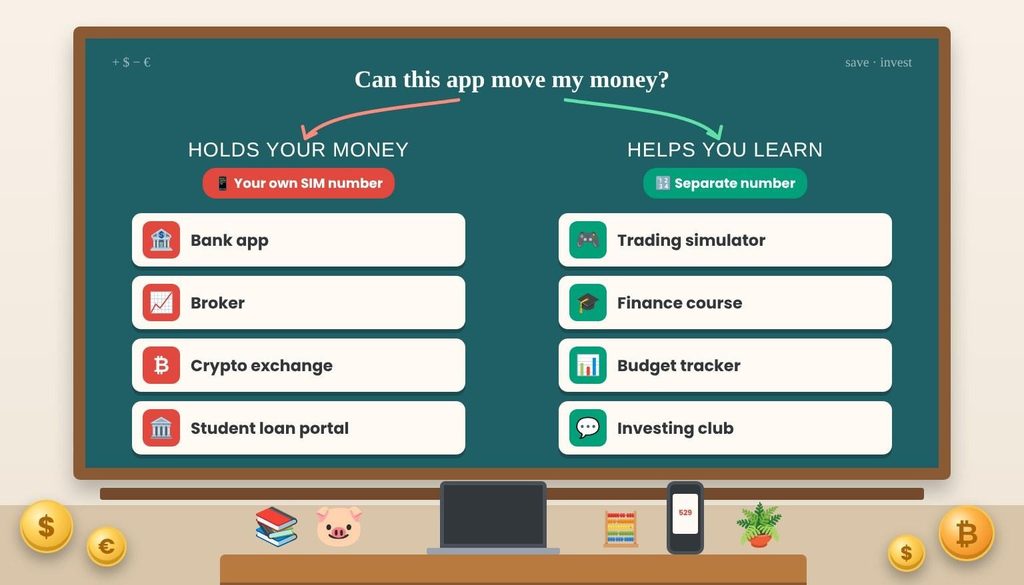
The simplest way to decide which number to share is to ask one question: can this app move, hold or lend my money? If it can, it gets your real number. If it only teaches, tracks or entertains, it does not need it.
| App type | Can it touch your money? | Which number |
| Bank and debit card app | Yes, it holds your balance | Your own SIM number |
| Broker or investment account | Yes, it holds your portfolio | Your own SIM number |
| Crypto exchange or wallet linked to it | Yes, deposits and withdrawals | Your own SIM number |
| Student loan or government finance portal | Yes, official records | Your own SIM number |
| Budgeting or spending tracker | No, it only reads or logs data | Separate number or long-term rental |
| Paper-trading simulator | No, virtual money only | Separate number |
| Finance course, webinar or newsletter | No, content only | Separate number |
| Investing community or forum | No, discussion only | Separate number or long-term rental |
If you are unsure, imagine losing access to the account in six months. If that would cost you money or block a payment, it belongs in the first group.
Learning tools that do not need your personal number
Most of what you install in your first investing year falls into the learning group. These are the usual suspects:
- paper-trading simulators that let you practice with virtual money;
- budgeting apps you test for a few weeks before picking one;
- online finance courses, webinars and challenge programs;
- newsletters and research tools that unlock content after sign-up;
- investing communities and student finance clubs on chat apps.
Many of these services also use your number for marketing calls, partner offers and “special deals” on paid plans. Keeping them on a separate number means those calls never reach your personal phone, and deleting an old account does not leave your contact behind.
How to set it up in five steps
The setup takes a few minutes and saves you a lot of cleanup later.
1. Write down every finance app you use or plan to try this year.
2. Mark the ones that hold money, lend money or connect to official records.
3. Keep all marked apps on your own SIM number and turn on an authenticator app where possible.
4. For unmarked apps you will only test, use a short activation number and delete the account if it does not earn its place.
5. For unmarked apps you plan to keep, such as a budgeting tool or a community, rent a number long-term so login codes still arrive next year.
Services such as SMSFAST cover 190+ countries and more than 500 platforms, with activations of 20 to 90 minutes for quick tests and rentals from one day to one year for tools you keep.
When your real number is the only right choice
A separate number protects your privacy during the learning phase. It is not a shortcut for accounts that need to know who you are. Banks, brokers and exchanges verify your identity by law, send security codes for withdrawals and use your phone to recover a locked account.
Never put a temporary number on any of these accounts. If the number expires, you lose the channel that protects your savings exactly when you need it. The same applies to tax, student finance and other government portals, where the number is part of an official record.
Practical caveats
Some apps detect virtual numbers and ask for a carrier number instead. That usually means the service wants a stable contact, so decide whether it is worth your real number or find an alternative. Activation numbers also expire quickly, which is fine for a one-week test but not for a tool you will open every month.
Finally, use a separate number to keep your personal contact private, not to open extra accounts that a platform’s rules do not allow. Bonus and referral programs usually limit one account per person, and breaking that rule can get every account closed.
The bottom line
Your first years of investing are about learning, and learning means trying many apps. Give simulators, courses, trackers and communities a separate number, and keep your bank, broker, exchange and official accounts on your own SIM with an authenticator app. Your personal number stays in a handful of trusted places, and your money stays protected by a contact you will still control years from now.